

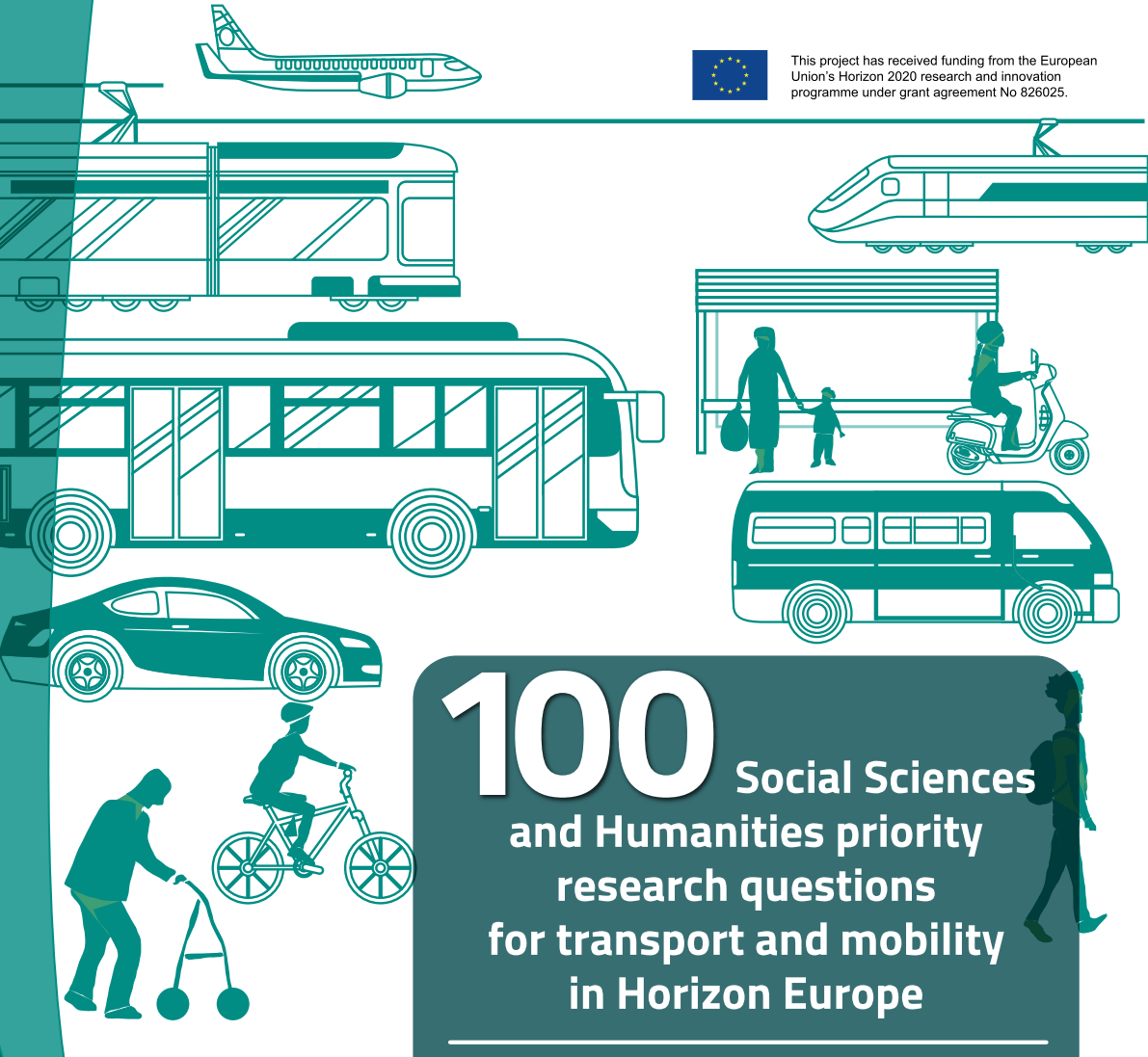
100 Social Sciences and Humanities priority research questions for transport and mobility

1.  Co-producing  knowledge  and  professional practices.

Questions focus on how to better facilitate learning across  different  professional  practices  such  as research, policy and planning.

2.  Scenarios,  futures,  visions  and  transition pathways

Questions  focus  on  how  a  sustainable  transport and mobility system should look like in the future and possible transition pathways to arrive at such visions.

3.  Dominant mobility regimes and car dependency

Questions focus on what stabilises, as well as ways to change or disrupt lock-ins created by the dominant  (auto)mobility  regime,  where  the  car  usually takes centre-stage.

4.  Governance, policies and incentives

Questions focus on the role of governance, policies and  incentives  in  shaping  current  transport  and mobility systems, and their effect on the development and implementation of different technologies and modes of transport.

5.  Participation and citizen engagement

Questions  focus  on  public  participation  and different methods to engage citizens in transport and mobility systems planning and realizations.

6.  Mobility practices and mobility needs

Questions  focus  everyday  experiences  with  and needs for mobility.

7.  Risks, disruptions and negative or unanticipated consequences

Questions  focus  on  disruptive  events  such  as natural disasters or global pandemics and associated  drawbacks  and  risks  related  to  low-carbon, autonomous or connected transport technologies.

8.  Social justice and inclusion

Questions  focus  on  how  sustainable  transport and  mobility  transitions  can  be  socially  just  and  inclusive.

Life expectancy and mortality in 363 cities of Latin America

Abstract

The concept of a so-called urban advantage in health ignores the possibility of heterogeneity in health outcomes across cities. Using a harmonized dataset from the SALURBAL project, we describe variability and predictors of life expectancy and proportionate mortality in 363 cities across nine Latin American countries. Life expectancy differed substantially across cities within the same country. Cause-specific mortality also varied across cities, with some causes of death (unintentional and violent injuries and deaths) showing large variation within countries, whereas other causes of death (communicable, maternal, neonatal and nutritional, cancer, cardiovascular disease and other noncommunicable diseases) varied substantially between countries. In multivariable mixed models, higher levels of education, water access and sanitation and less overcrowding were associated with longer life expectancy, a relatively lower proportion of communicable, maternal, neonatal and nutritional deaths and a higher proportion of deaths from cancer, cardiovascular disease and other noncommunicable diseases. These results highlight considerable heterogeneity in life expectancy and causes of death across cities of Latin America, revealing modifiable factors that could be amenable to urban policies aimed toward improving urban health in Latin America and more generally in other urban environments.

plugins premium WordPress