

Life expectancy and mortality in 363 cities of Latin America

Abstract

The concept of a so-called urban advantage in health ignores the possibility of heterogeneity in health outcomes across cities. Using a harmonized dataset from the SALURBAL project, we describe variability and predictors of life expectancy and proportionate mortality in 363 cities across nine Latin American countries. Life expectancy differed substantially across cities within the same country. Cause-specific mortality also varied across cities, with some causes of death (unintentional and violent injuries and deaths) showing large variation within countries, whereas other causes of death (communicable, maternal, neonatal and nutritional, cancer, cardiovascular disease and other noncommunicable diseases) varied substantially between countries. In multivariable mixed models, higher levels of education, water access and sanitation and less overcrowding were associated with longer life expectancy, a relatively lower proportion of communicable, maternal, neonatal and nutritional deaths and a higher proportion of deaths from cancer, cardiovascular disease and other noncommunicable diseases. These results highlight considerable heterogeneity in life expectancy and causes of death across cities of Latin America, revealing modifiable factors that could be amenable to urban policies aimed toward improving urban health in Latin America and more generally in other urban environments.

Transit Cost Project

Construction Cost of Urban Rail Project All Over the World

Transit Cost Project

About

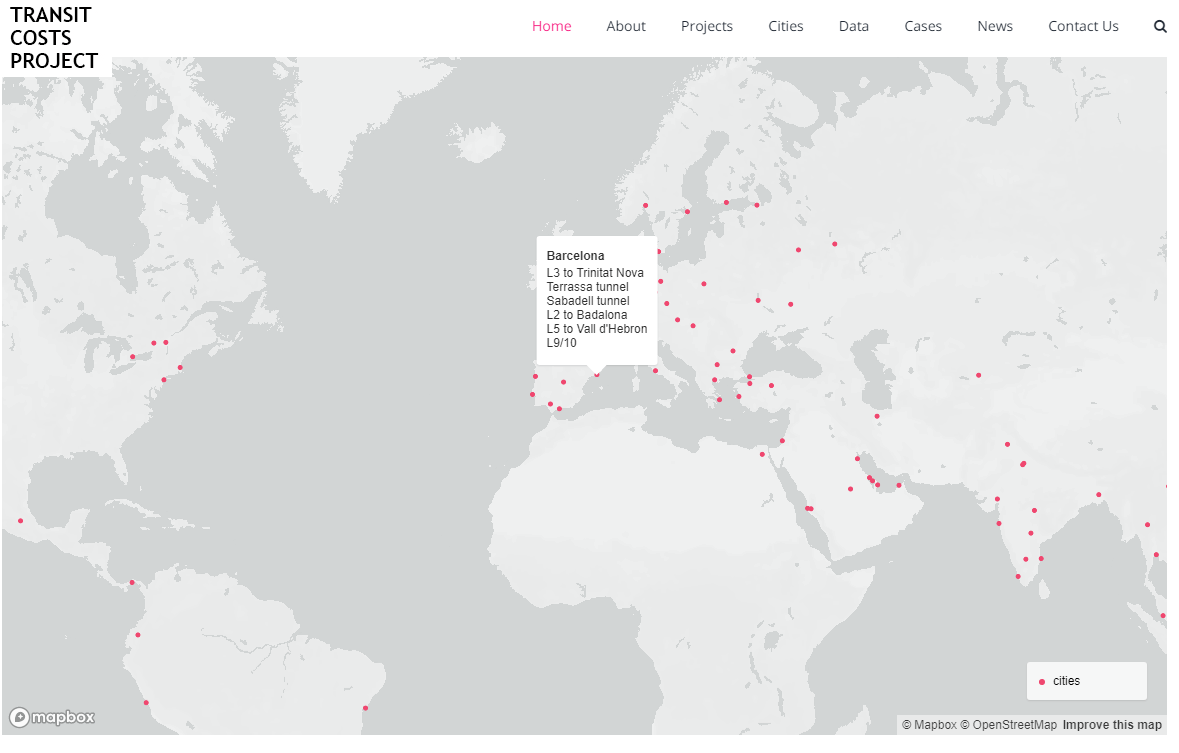
Why do transit-infrastructure projects in New York cost 20 times more on a per kilometer basis than in Seoul? We investigate this question across hundreds of transit projects from around the world. We have created a database that spans more than 50 countries and totals more than 11,000 km of urban rail built since the late 1990s. We will also examine this question in greater detail by carrying out six in-depth case studies that take a closer look at unique considerations and variables that aren’t easily quantified, like project management, governance, and site conditions.

The goal of this work is to figure out how to deliver more high-capacity transit projects for a fraction of the cost in countries like the United States. Additionally, we hope that our site will be a useful resource for elected officials, planners, researchers, journalists, advocates, and others interested in contextualizing transit-infrastructure costs and fighting for better projects.

If you have ideas and evidence about why transit costs vary so greatly from one country to the next or you just want to connect with us, please get in touch at info[at]transitcosts.com or click on the “Contact Us” tab. We are trying our best to get things right, but we don’t know everything and we will invariably make mistakes. Correct us and expand our understanding of transit-infrastructure planning, construction, and financing. We are always looking for new projects, data, corrections, resources, and feedback. 

We are a group of researchers under the umbrella of the NYU Marron Institute of Urban Management, but our team is spread across the globe. Our research is supported by Arnold Ventures, Andrew and Carolyn Chatham, and others.

plugins premium WordPress